“Newton’s laws” redirects here. For other uses, see Newton’s law. “F=ma” redirects here. For the physics competition, see F=ma exam.
| Part of a series on |
| Classical mechanics |
|---|
F=dpdt Second law of motion Second law of motion |
| HistoryTimelineTextbooks |
| Branches |
| Fundamentals |
| Formulations |
| Core topics |
| Rotation |
| Scientists |
Physics portal Category Category |
| vte |
Newton’s laws of motion are three physical laws that describe the relationship between the motion of an object and the forces acting on it. These laws, which provide the basis for Newtonian mechanics, can be paraphrased as follows:
- A body remains at rest, or in motion at a constant speed in a straight line, unless it is acted upon by a force.
- At any instant of time, the net force on a body is equal to the body’s acceleration multiplied by its mass or, equivalently, the rate at which the body’s momentum is changing with time.
- If two bodies exert forces on each other, these forces have the same magnitude but opposite directions.[1][2]
The three laws of motion were first stated by Isaac Newton in his Philosophiæ Naturalis Principia Mathematica (Mathematical Principles of Natural Philosophy), originally published in 1687.[3] Newton used them to investigate and explain the motion of many physical objects and systems. In the time since Newton, new insights, especially around the concept of energy, built the field of classical mechanics on his foundations. In modern times, limitations to Newton’s laws have been discovered; new theories were consequently developed, such as quantum mechanics and relativity to address the physics of objects in more extreme cases.
Prerequisites
Newton’s laws are often stated in terms of point or particle masses, that is, bodies whose volume is negligible. This is a reasonable approximation for real bodies when the motion of internal parts can be neglected, and when the separation between bodies is much larger than the size of each. For instance, the Earth and the Sun can both be approximated as pointlike when considering the orbit of the former around the latter, but the Earth is not pointlike when considering activities on its surface.[note 1]
The mathematical description of motion, or kinematics, is based on the idea of specifying positions using numerical coordinates. Movement is represented by these numbers changing over time: a body’s trajectory is represented by a function that assigns to each value of a time variable the values of all the position coordinates. The simplest case is one-dimensional, that is, when a body is constrained to move only along a straight line. Its position can then be given by a single number, indicating where it is relative to some chosen reference point. For example, a body might be free to slide along a track that runs left to right, and so its location can be specified by its distance from a convenient zero point, or origin, with negative numbers indicating positions to the left and positive numbers indicating positions to the right. If the body’s location as a function of time is s(t)


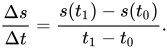


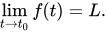


Position, when thought of as a displacement from an origin point, is a vector: a quantity with both magnitude and direction.[9]: 1 Velocity and acceleration are vector quantities as well. The mathematical tools of vector algebra provide the means to describe motion in two, three or more dimensions. Vectors are often denoted with an arrow, as in s→


The study of mechanics is complicated by the fact that household words like energy are used with a technical meaning.[10][11] Moreover, words which are synonymous in everyday speech are not so in physics: force is not the same as power or pressure, for example, and mass has a different meaning than weight.[12][13]: 150 The physics concept of force makes quantitative the everyday idea of a push or a pull. Forces in Newtonian mechanics are often due to strings and ropes, friction, muscle effort, gravity, and so forth. Like displacement, velocity, and acceleration, force is a vector quantity.
Laws
First law

Translated from Latin, Newton’s first law reads,Every object perseveres in its state of rest, or of uniform motion in a right line, unless it is compelled to change that state by forces impressed thereon.[note 3]
Newton’s first law expresses the principle of inertia: the natural behavior of a body is to move in a straight line at constant speed. A body’s motion preserves the status quo, but external forces can perturb this.
The modern understanding of Newton’s first law is that no inertial observer is privileged over any other. The concept of an inertial observer makes quantitative the everyday idea of feeling no effects of motion. For example, a person standing on the ground watching a train go past is an inertial observer. If the observer on the ground sees the train moving smoothly in a straight line at a constant speed, then a passenger sitting on the train will also be an inertial observer: the train passenger feels no motion. The principle expressed by Newton’s first law is that there is no way to say which inertial observer is “really” moving and which is “really” standing still. One observer’s state of rest is another observer’s state of uniform motion in a straight line, and no experiment can deem either point of view to be correct or incorrect. There is no absolute standard of rest.[18][15]: 62–63 [19]: 7–9 Newton himself believed that absolute space and time existed, but that the only measures of space or time accessible to experiment are relative.[20]
Second law
The change of motion of an object is proportional to the force impressed; and is made in the direction of the straight line in which the force is impressed.[15]: 114
By “motion”, Newton meant the quantity now called momentum, which depends upon the amount of matter contained in a body, the speed at which that body is moving, and the direction in which it is moving.[21] In modern notation, the momentum of a body is the product of its mass and its velocity:p=mv,


Newton’s second law, in modern form, states that the time derivative of the momentum is the force:[23]: 4.1 F=dpdt.


The forces acting on a body add as vectors, and so the total force on a body depends upon both the magnitudes and the directions of the individual forces.[23]: 58 When the net force on a body is equal to zero, then by Newton’s second law, the body does not accelerate, and it is said to be in mechanical equilibrium. A state of mechanical equilibrium is stable if, when the position of the body is changed slightly, the body remains near that equilibrium. Otherwise, the equilibrium is unstable.[15]: 121 [23]: 174
A common visual representation of forces acting in concert is the free body diagram, which schematically portrays a body of interest and the forces applied to it by outside influences.[26] For example, a free body diagram of a block sitting upon an inclined plane can illustrate the combination of gravitational force, “normal” force, friction, and string tension.[note 4]
Newton’s second law is sometimes presented as a definition of force, i.e., a force is that which exists when an inertial observer sees a body accelerating. This is sometimes regarded as a potential tautology — acceleration implies force, force implies acceleration. To go beyond tautology, an equation detailing the force might also be specified, like Newton’s law of universal gravitation. By inserting such an expression for F
Third law
To every action, there is always opposed an equal reaction; or, the mutual actions of two bodies upon each other are always equal, and directed to contrary parts.[15]: 116
.jpg)
In other words, if one body exerts a force on a second body, the second body is also exerting a force on the first body, of equal magnitude in the opposite direction. Overly brief paraphrases of the third law, like “action equals reaction” might have caused confusion among generations of students: the “action” and “reaction” apply to different bodies. For example, consider a book at rest on a table. The Earth’s gravity pulls down upon the book. The “reaction” to that “action” is not the support force from the table holding up the book, but the gravitational pull of the book acting on the Earth.[note 6]
Newton’s third law relates to a more fundamental principle, the conservation of momentum. The latter remains true even in cases where Newton’s statement does not, for instance when force fields as well as material bodies carry momentum, and when momentum is defined properly, in quantum mechanics as well.[note 7] In Newtonian mechanics, if two bodies have momenta p1


Candidates for additional laws
Various sources have proposed elevating other ideas used in classical mechanics to the status of Newton’s laws. For example, in Newtonian mechanics, the total mass of a body made by bringing together two smaller bodies is the sum of their individual masses. Frank Wilczek has suggested calling attention to this assumption by designating it “Newton’s Zeroth Law”.[37] Another candidate for a “zeroth law” is the fact that at any instant, a body reacts to the forces applied to it at that instant.[38] Likewise, the idea that forces add like vectors (or in other words obey the superposition principle), and the idea that forces change the energy of a body, have both been described as a “fourth law”.[note 8]
Moreover, some texts organize the basic ideas of Newtonian mechanics into different postulates, other than the three laws as commonly phrased, with the goal of being more clear about what is empirically observed and what is true by definition.[19]: 9 [27]
Examples
The study of the behavior of massive bodies using Newton’s laws is known as Newtonian mechanics. Some example problems in Newtonian mechanics are particularly noteworthy for conceptual or historical reasons.
Uniformly accelerated motion
Main articles: Free fall and Projectile motion

If a body falls from rest near the surface of the Earth, then in the absence of air resistance, it will accelerate at a constant rate. This is known as free fall. The speed attained during free fall is proportional to the elapsed time, and the distance traveled is proportional to the square of the elapsed time.[43] Importantly, the acceleration is the same for all bodies, independently of their mass. This follows from combining Newton’s second law of motion with his law of universal gravitation. The latter states that the magnitude of the gravitational force from the Earth upon the body isF=GMmr2,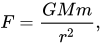


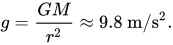

If the body is not released from rest but instead launched upwards and/or horizontally with nonzero velocity, then free fall becomes projectile motion.[44] When air resistance can be neglected, projectiles follow parabola-shaped trajectories, because gravity affects the body’s vertical motion and not its horizontal. At the peak of the projectile’s trajectory, its vertical velocity is zero, but its acceleration is g
Uniform circular motion
Main article: Circular motion

When a body is in uniform circular motion, the force on it changes the direction of its motion but not its speed. For a body moving in a circle of radius r


Newton’s cannonball is a thought experiment that interpolates between projectile motion and uniform circular motion. A cannonball that is lobbed weakly off the edge of a tall cliff will hit the ground in the same amount of time as if it were dropped from rest, because the force of gravity only affects the cannonball’s momentum in the downward direction, and its effect is not diminished by horizontal movement. If the cannonball is launched with a greater initial horizontal velocity, then it will travel farther before it hits the ground, but it will still hit the ground in the same amount of time. However, if the cannonball is launched with an even larger initial velocity, then the curvature of the Earth becomes significant: the ground itself will curve away from the falling cannonball. A very fast cannonball will fall away from the inertial straight-line trajectory at the same rate that the Earth curves away beneath it; in other words, it will be in orbit (imagining that it is not slowed by air resistance or obstacles).[48]
Harmonic motion
Main article: Harmonic oscillator

Consider a body of mass m





One reason that the harmonic oscillator is a conceptually important example is that it is good approximation for many systems near a stable mechanical equilibrium.[note 10] For example, a pendulum has a stable equilibrium in the vertical position: if motionless there, it will remain there, and if pushed slightly, it will swing back and forth. Neglecting air resistance and friction in the pivot, the force upon the pendulum is gravity, and Newton’s second law becomesd2θdt2=−gLsinθ,


A harmonic oscillator can be damped, often by friction or viscous drag, in which case energy bleeds out of the oscillator and the amplitude of the oscillations decreases over time. Also, a harmonic oscillator can be driven by an applied force, which can lead to the phenomenon of resonance.[50]
Objects with variable mass
Main article: Variable-mass system

Newtonian physics treats matter as being neither created nor destroyed, though it may be rearranged. It can be the case that an object of interest gains or loses mass because matter is added to or removed from it. In such a situation, Newton’s laws can be applied to the individual pieces of matter, keeping track of which pieces belong to the object of interest over time. For instance, if a rocket of mass M(t)


Fan and sail

The fan and sail example is a situation studied in discussions of Newton’s third law.[51] In the situation, a fan is attached to a cart or a sailboat and blows on its sail. From the third law, one would reason that the force of the air pushing in one direction would cancel out the force done by the fan on the sail, leaving the entire apparatus stationary. However, because the system is not entirely enclosed, there are conditions in which the vessel will move; for example, if the sail is built in a manner that redirects the majority of the airflow back towards the fan, the net force will result in the vessel moving forward.[34][52]
Work and energy
The concept of energy was developed after Newton’s time, but it has become an inseparable part of what is considered “Newtonian” physics. Energy can broadly be classified into kinetic, due to a body’s motion, and potential, due to a body’s position relative to others. Thermal energy, the energy carried by heat flow, is a type of kinetic energy not associated with the macroscopic motion of objects but instead with the movements of the atoms and molecules of which they are made. According to the work-energy theorem, when a force acts upon a body while that body moves along the line of the force, the force does work upon the body, and the amount of work done is equal to the change in the body’s kinetic energy.[note 11] In many cases of interest, the net work done by a force when a body moves in a closed loop — starting at a point, moving along some trajectory, and returning to the initial point — is zero. If this is the case, then the force can be written in terms of the gradient of a function called a scalar potential:[46]: 303 F=−∇U.
Rigid-body motion and rotation
Main article: Rigid-body motion
A rigid body is an object whose size is too large to neglect and which maintains the same shape over time. In Newtonian mechanics, the motion of a rigid body is often understood by separating it into movement of the body’s center of mass and movement around the center of mass.
Center of mass
Main article: Center of mass

Significant aspects of the motion of an extended body can be understood by imagining the mass of that body concentrated to a single point, known as the center of mass. The location of a body’s center of mass depends upon how that body’s material is distributed. For a collection of pointlike objects with masses m1,…,mN


Rotational analogues of Newton’s laws
When Newton’s laws are applied to rotating extended bodies, they lead to new quantities that are analogous to those invoked in the original laws. The analogue of mass is the moment of inertia, the counterpart of momentum is angular momentum, and the counterpart of force is torque.
Angular momentum is calculated with respect to a reference point.[56] If the displacement vector from a reference point to a body is r


The angular momentum of a collection of point masses, and thus of an extended body, is found by adding the contributions from each of the points. This provides a means to characterize a body’s rotation about an axis, by adding up the angular momenta of its individual pieces. The result depends on the chosen axis, the shape of the body, and the rate of rotation.[19]: 28
Multi-body gravitational system
Main articles: Two-body problem and Three-body problem

Newton’s law of universal gravitation states that any body attracts any other body along the straight line connecting them. The size of the attracting force is proportional to the product of their masses, and inversely proportional to the square of the distance between them. Finding the shape of the orbits that an inverse-square force law will produce is known as the Kepler problem. The Kepler problem can be solved in multiple ways, including by demonstrating that the Laplace–Runge–Lenz vector is constant,[57] or by applying a duality transformation to a 2-dimensional harmonic oscillator.[58] However it is solved, the result is that orbits will be conic sections, that is, ellipses (including circles), parabolas, or hyperbolas. The eccentricity of the orbit, and thus the type of conic section, is determined by the energy and the angular momentum of the orbiting body. Planets do not have sufficient energy to escape the Sun, and so their orbits are ellipses, to a good approximation; because the planets pull on one another, actual orbits are not exactly conic sections.
If a third mass is added, the Kepler problem becomes the three-body problem, which in general has no exact solution in closed form. That is, there is no way to start from the differential equations implied by Newton’s laws and, after a finite sequence of standard mathematical operations, obtain equations that express the three bodies’ motions over time.[59][60] Numerical methods can be applied to obtain useful, albeit approximate, results for the three-body problem.[61] The positions and velocities of the bodies can be stored in variables within a computer’s memory; Newton’s laws are used to calculate how the velocities will change over a short interval of time, and knowing the velocities, the changes of position over that time interval can be computed. This process is looped to calculate, approximately, the bodies’ trajectories. Generally speaking, the shorter the time interval, the more accurate the approximation.[62]
| Parameter | Value Mass |
|---|
“Newton’s laws” redirects here. For other uses, see Newton’s law. “F=ma” redirects here. For the physics competition, see F=ma exam.
| Part of a series on |
| Classical mechanics |
|---|
| F=dpdtSecond law of motion |
| HistoryTimelineTextbooks |
| Branches |
| Fundamentals |
| Formulations |
| Core topics |
| Rotation |
| Scientists |
| Physics portal Category |
| vte |
Newton’s laws of motion are three physical laws that describe the relationship between the motion of an object and the forces acting on it. These laws, which provide the basis for Newtonian mechanics, can be paraphrased as follows:
- A body remains at rest, or in motion at a constant speed in a straight line, unless it is acted upon by a force.
- At any instant of time, the net force on a body is equal to the body’s acceleration multiplied by its mass or, equivalently, the rate at which the body’s momentum is changing with time.
- If two bodies exert forces on each other, these forces have the same magnitude but opposite directions.[1][2]
The three laws of motion were first stated by Isaac Newton in his Philosophiæ Naturalis Principia Mathematica (Mathematical Principles of Natural Philosophy), originally published in 1687.[3] Newton used them to investigate and explain the motion of many physical objects and systems. In the time since Newton, new insights, especially around the concept of energy, built the field of classical mechanics on his foundations. In modern times, limitations to Newton’s laws have been discovered; new theories were consequently developed, such as quantum mechanics and relativity to address the physics of objects in more extreme cases.
Prerequisites
Newton’s laws are often stated in terms of point or particle masses, that is, bodies whose volume is negligible. This is a reasonable approximation for real bodies when the motion of internal parts can be neglected, and when the separation between bodies is much larger than the size of each. For instance, the Earth and the Sun can both be approximated as pointlike when considering the orbit of the former around the latter, but the Earth is not pointlike when considering activities on its surface.[note 1]
The mathematical description of motion, or kinematics, is based on the idea of specifying positions using numerical coordinates. Movement is represented by these numbers changing over time: a body’s trajectory is represented by a function that assigns to each value of a time variable the values of all the position coordinates. The simplest case is one-dimensional, that is, when a body is constrained to move only along a straight line. Its position can then be given by a single number, indicating where it is relative to some chosen reference point. For example, a body might be free to slide along a track that runs left to right, and so its location can be specified by its distance from a convenient zero point, or origin, with negative numbers indicating positions to the left and positive numbers indicating positions to the right. If the body’s location as a function of time is s(t)
Position, when thought of as a displacement from an origin point, is a vector: a quantity with both magnitude and direction.[9]: 1 Velocity and acceleration are vector quantities as well. The mathematical tools of vector algebra provide the means to describe motion in two, three or more dimensions. Vectors are often denoted with an arrow, as in s→
The study of mechanics is complicated by the fact that household words like energy are used with a technical meaning.[10][11] Moreover, words which are synonymous in everyday speech are not so in physics: force is not the same as power or pressure, for example, and mass has a different meaning than weight.[12][13]: 150 The physics concept of force makes quantitative the everyday idea of a push or a pull. Forces in Newtonian mechanics are often due to strings and ropes, friction, muscle effort, gravity, and so forth. Like displacement, velocity, and acceleration, force is a vector quantity.
Laws
First law
Translated from Latin, Newton’s first law reads,Every object perseveres in its state of rest, or of uniform motion in a right line, unless it is compelled to change that state by forces impressed thereon.[note 3]
Newton’s first law expresses the principle of inertia: the natural behavior of a body is to move in a straight line at constant speed. A body’s motion preserves the status quo, but external forces can perturb this.
The modern understanding of Newton’s first law is that no inertial observer is privileged over any other. The concept of an inertial observer makes quantitative the everyday idea of feeling no effects of motion. For example, a person standing on the ground watching a train go past is an inertial observer. If the observer on the ground sees the train moving smoothly in a straight line at a constant speed, then a passenger sitting on the train will also be an inertial observer: the train passenger feels no motion. The principle expressed by Newton’s first law is that there is no way to say which inertial observer is “really” moving and which is “really” standing still. One observer’s state of rest is another observer’s state of uniform motion in a straight line, and no experiment can deem either point of view to be correct or incorrect. There is no absolute standard of rest.[18][15]: 62–63 [19]: 7–9 Newton himself believed that absolute space and time existed, but that the only measures of space or time accessible to experiment are relative.[20]
Second law
The change of motion of an object is proportional to the force impressed; and is made in the direction of the straight line in which the force is impressed.[15]: 114
By “motion”, Newton meant the quantity now called momentum, which depends upon the amount of matter contained in a body, the speed at which that body is moving, and the direction in which it is moving.[21] In modern notation, the momentum of a body is the product of its mass and its velocity:p=mv,
Newton’s second law, in modern form, states that the time derivative of the momentum is the force:[23]: 4.1 F=dpdt.
The forces acting on a body add as vectors, and so the total force on a body depends upon both the magnitudes and the directions of the individual forces.[23]: 58 When the net force on a body is equal to zero, then by Newton’s second law, the body does not accelerate, and it is said to be in mechanical equilibrium. A state of mechanical equilibrium is stable if, when the position of the body is changed slightly, the body remains near that equilibrium. Otherwise, the equilibrium is unstable.[15]: 121 [23]: 174
A common visual representation of forces acting in concert is the free body diagram, which schematically portrays a body of interest and the forces applied to it by outside influences.[26] For example, a free body diagram of a block sitting upon an inclined plane can illustrate the combination of gravitational force, “normal” force, friction, and string tension.[note 4]
Newton’s second law is sometimes presented as a definition of force, i.e., a force is that which exists when an inertial observer sees a body accelerating. This is sometimes regarded as a potential tautology — acceleration implies force, force implies acceleration. To go beyond tautology, an equation detailing the force might also be specified, like Newton’s law of universal gravitation. By inserting such an expression for F
Third law
To every action, there is always opposed an equal reaction; or, the mutual actions of two bodies upon each other are always equal, and directed to contrary parts.[15]: 116
In other words, if one body exerts a force on a second body, the second body is also exerting a force on the first body, of equal magnitude in the opposite direction. Overly brief paraphrases of the third law, like “action equals reaction” might have caused confusion among generations of students: the “action” and “reaction” apply to different bodies. For example, consider a book at rest on a table. The Earth’s gravity pulls down upon the book. The “reaction” to that “action” is not the support force from the table holding up the book, but the gravitational pull of the book acting on the Earth.[note 6]
Newton’s third law relates to a more fundamental principle, the conservation of momentum. The latter remains true even in cases where Newton’s statement does not, for instance when force fields as well as material bodies carry momentum, and when momentum is defined properly, in quantum mechanics as well.[note 7] In Newtonian mechanics, if two bodies have momenta p1
Candidates for additional laws
Various sources have proposed elevating other ideas used in classical mechanics to the status of Newton’s laws. For example, in Newtonian mechanics, the total mass of a body made by bringing together two smaller bodies is the sum of their individual masses. Frank Wilczek has suggested calling attention to this assumption by designating it “Newton’s Zeroth Law”.[37] Another candidate for a “zeroth law” is the fact that at any instant, a body reacts to the forces applied to it at that instant.[38] Likewise, the idea that forces add like vectors (or in other words obey the superposition principle), and the idea that forces change the energy of a body, have both been described as a “fourth law”.[note 8]
Moreover, some texts organize the basic ideas of Newtonian mechanics into different postulates, other than the three laws as commonly phrased, with the goal of being more clear about what is empirically observed and what is true by definition.[19]: 9 [27]
Examples
The study of the behavior of massive bodies using Newton’s laws is known as Newtonian mechanics. Some example problems in Newtonian mechanics are particularly noteworthy for conceptual or historical reasons.
Uniformly accelerated motion
Main articles: Free fall and Projectile motion
If a body falls from rest near the surface of the Earth, then in the absence of air resistance, it will accelerate at a constant rate. This is known as free fall. The speed attained during free fall is proportional to the elapsed time, and the distance traveled is proportional to the square of the elapsed time.[43] Importantly, the acceleration is the same for all bodies, independently of their mass. This follows from combining Newton’s second law of motion with his law of universal gravitation. The latter states that the magnitude of the gravitational force from the Earth upon the body isF=GMmr2,
If the body is not released from rest but instead launched upwards and/or horizontally with nonzero velocity, then free fall becomes projectile motion.[44] When air resistance can be neglected, projectiles follow parabola-shaped trajectories, because gravity affects the body’s vertical motion and not its horizontal. At the peak of the projectile’s trajectory, its vertical velocity is zero, but its acceleration is g
Uniform circular motion
Main article: Circular motion
When a body is in uniform circular motion, the force on it changes the direction of its motion but not its speed. For a body moving in a circle of radius r
Newton’s cannonball is a thought experiment that interpolates between projectile motion and uniform circular motion. A cannonball that is lobbed weakly off the edge of a tall cliff will hit the ground in the same amount of time as if it were dropped from rest, because the force of gravity only affects the cannonball’s momentum in the downward direction, and its effect is not diminished by horizontal movement. If the cannonball is launched with a greater initial horizontal velocity, then it will travel farther before it hits the ground, but it will still hit the ground in the same amount of time. However, if the cannonball is launched with an even larger initial velocity, then the curvature of the Earth becomes significant: the ground itself will curve away from the falling cannonball. A very fast cannonball will fall away from the inertial straight-line trajectory at the same rate that the Earth curves away beneath it; in other words, it will be in orbit (imagining that it is not slowed by air resistance or obstacles).[48]
Harmonic motion
Main article: Harmonic oscillator
Consider a body of mass m
One reason that the harmonic oscillator is a conceptually important example is that it is good approximation for many systems near a stable mechanical equilibrium.[note 10] For example, a pendulum has a stable equilibrium in the vertical position: if motionless there, it will remain there, and if pushed slightly, it will swing back and forth. Neglecting air resistance and friction in the pivot, the force upon the pendulum is gravity, and Newton’s second law becomesd2θdt2=−gLsinθ,
A harmonic oscillator can be damped, often by friction or viscous drag, in which case energy bleeds out of the oscillator and the amplitude of the oscillations decreases over time. Also, a harmonic oscillator can be driven by an applied force, which can lead to the phenomenon of resonance.[50]
Objects with variable mass
Main article: Variable-mass system
Newtonian physics treats matter as being neither created nor destroyed, though it may be rearranged. It can be the case that an object of interest gains or loses mass because matter is added to or removed from it. In such a situation, Newton’s laws can be applied to the individual pieces of matter, keeping track of which pieces belong to the object of interest over time. For instance, if a rocket of mass M(t)
Fan and sail
The fan and sail example is a situation studied in discussions of Newton’s third law.[51] In the situation, a fan is attached to a cart or a sailboat and blows on its sail. From the third law, one would reason that the force of the air pushing in one direction would cancel out the force done by the fan on the sail, leaving the entire apparatus stationary. However, because the system is not entirely enclosed, there are conditions in which the vessel will move; for example, if the sail is built in a manner that redirects the majority of the airflow back towards the fan, the net force will result in the vessel moving forward.[34][52]
Work and energy
The concept of energy was developed after Newton’s time, but it has become an inseparable part of what is considered “Newtonian” physics. Energy can broadly be classified into kinetic, due to a body’s motion, and potential, due to a body’s position relative to others. Thermal energy, the energy carried by heat flow, is a type of kinetic energy not associated with the macroscopic motion of objects but instead with the movements of the atoms and molecules of which they are made. According to the work-energy theorem, when a force acts upon a body while that body moves along the line of the force, the force does work upon the body, and the amount of work done is equal to the change in the body’s kinetic energy.[note 11] In many cases of interest, the net work done by a force when a body moves in a closed loop — starting at a point, moving along some trajectory, and returning to the initial point — is zero. If this is the case, then the force can be written in terms of the gradient of a function called a scalar potential:[46]: 303 F=−∇U.
Rigid-body motion and rotation
Main article: Rigid-body motion
A rigid body is an object whose size is too large to neglect and which maintains the same shape over time. In Newtonian mechanics, the motion of a rigid body is often understood by separating it into movement of the body’s center of mass and movement around the center of mass.
Center of mass
Main article: Center of mass
Significant aspects of the motion of an extended body can be understood by imagining the mass of that body concentrated to a single point, known as the center of mass. The location of a body’s center of mass depends upon how that body’s material is distributed. For a collection of pointlike objects with masses m1,…,mN
Rotational analogues of Newton’s laws
When Newton’s laws are applied to rotating extended bodies, they lead to new quantities that are analogous to those invoked in the original laws. The analogue of mass is the moment of inertia, the counterpart of momentum is angular momentum, and the counterpart of force is torque.
Angular momentum is calculated with respect to a reference point.[56] If the displacement vector from a reference point to a body is r
The angular momentum of a collection of point masses, and thus of an extended body, is found by adding the contributions from each of the points. This provides a means to characterize a body’s rotation about an axis, by adding up the angular momenta of its individual pieces. The result depends on the chosen axis, the shape of the body, and the rate of rotation.[19]: 28
Multi-body gravitational system
Main articles: Two-body problem and Three-body problem
Newton’s law of universal gravitation states that any body attracts any other body along the straight line connecting them. The size of the attracting force is proportional to the product of their masses, and inversely proportional to the square of the distance between them. Finding the shape of the orbits that an inverse-square force law will produce is known as the Kepler problem. The Kepler problem can be solved in multiple ways, including by demonstrating that the Laplace–Runge–Lenz vector is constant,[57] or by applying a duality transformation to a 2-dimensional harmonic oscillator.[58] However it is solved, the result is that orbits will be conic sections, that is, ellipses (including circles), parabolas, or hyperbolas. The eccentricity of the orbit, and thus the type of conic section, is determined by the energy and the angular momentum of the orbiting body. Planets do not have sufficient energy to escape the Sun, and so their orbits are ellipses, to a good approximation; because the planets pull on one another, actual orbits are not exactly conic sections.
If a third mass is added, the Kepler problem becomes the three-body problem, which in general has no exact solution in closed form. That is, there is no way to start from the differential equations implied by Newton’s laws and, after a finite sequence of standard mathematical operations, obtain equations that express the three bodies’ motions over time.[59][60] Numerical methods can be applied to obtain useful, albeit approximate, results for the three-body problem.[61] The positions and velocities of the bodies can be stored in variables within a computer’s memory; Newton’s laws are used to calculate how the velocities will change over a short interval of time, and knowing the velocities, the changes of position over that time interval can be computed. This process is looped to calculate, approximately, the bodies’ trajectories. Generally speaking, the shorter the time interval, the more accurate the approximation.[62]
| Parameter | Value Mass |
|---|